


In addition to procedures for ensuring internal quality, accredited testing laboratories must monitor their performance by comparing their results with those of other laboratories. Regular participation in interlaboratory comparisons (also known as "ring tests" or "round robin tests") is one way to meet this requirement.
In accordance with the DIN EN ISO/IEC 17025 standard, this performance comparison can also be achieved through participation in interlaboratory or bilateral comparisons. This ensures the consistent and high quality of their results and reliably demonstrates their competence to customers and regulatory authorities.
SPEKTRA is accredited in accordance with the standard and regularly participates in Interlaboratory Comparison (ILC) programs for various measurement parameters or calibration procedures. Please contact us if you are interested in a comparison!

Would you like to initiate a proficiency test or participate in a comparison? Rely on our metrology experts for all your challenges. Ensure that your measurement setup is equipped with precise and calibrated equipment.
SPEKTRA LABS is here to help! With components such as exciters, controllers and amplifiers. From hardware and software to complete system solutions — all from a single source. With accredited calibration services in our labs… and much more!
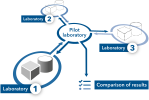
What is a round-robin test?
A round-robin test or interlaboratory comparison (ILC) is a performance test for accredited calibration laboratories. It is a method of external quality assurance for laboratories and their measurement procedures. In this process, identical test specimens are analyzed one after another by the individual laboratories using similar or different methods.
Comparing the measurement results among the participants allows conclusions to be drawn about measurement uncertainty in general, as well as about the quality of the measurements made by all participants.
In addition, interlaboratory tests can be used to validate procedures for calibration tasks.
Round-robin testing, also known internationally as Interlaboratory Comparison (ILC), is used in the following cases:
- Quality assurance of laboratory tests and measurements
- Verification of the measurement uncertainty of a measurement procedure
- Comparison of calibration processes with other laboratories
- Compliance with the requirements of ISO 17025:2018
- Demonstration of competence to customers, supervisors and regulatory authorities
Round robin test for the measurand vibration in low, medium and high frequency ranges.
Round robin test in the frequency range
- CS ILC VLF (very low frequency)
0,2 Hz…160 Hz - CS ILC MF (medium frequency)
3 Hz…10 kHz - CS ILC HF (high frequency)
5 Hz…20 kHz
Primary laser round robin test for the measurand vibration in the high and low frequency ranges
Round robin test in the frequency range
- CS ILC Primär HF (high frequency)
5 Hz…20 kHz - CS ILC Seismic
0,1 Hz...160 Hz
In the field of seismology, we can offer on demand the round robin test in the frequency range 0.05 Hz…400 Hz)
Secondary calibration of shock accelerometers
Round robin test or bilateral comparison in the amplitude range:
- CS ILC LMS & LS (low medium shock & low shock)
200 m/s2…2 000 m/s2 - CS ILC MS (medium shock)
2 000 m/s2…100 000 m/s2 - CS ILC DTI (digital transducer interface)
200 m/s2…2 000 m/s2
Interlaboratory comparison for acoustic measurands and measuring equipment.
Round robin test in the frequency range
- CS ILC MicP (calibration in pressure chamber)
31,5 Hz…16 kHz - CS ILC MicFF (free-field calibration)
125 Hz…20 kHz - CS ILC for sound calibrators and pistonphones, depending
on the operating point of the reference device under test
Round robin test for signal conditioners from low to very high frequency ranges in alignment with the client or participant.
- CS ILC ESC (electrical signal conditioner)
0,2 Hz…50 kHz - or in alignment with the operating range of the customer
Background and standards
The initiative and process for an interlaboratory comparison are defined in the following standards:
- DIN EN ISO/IEC 17025 (2018–03): General requirements for the competence of testing and calibration laboratories
- According to DAkkS policy document 71 SD 0 010: “Inclusion of proficiency testing in accreditation,” participation in round robin test as a proficiency test is mandatory at least once per accreditation interval and per measurement quantity
Who can participate in a round robin test?
Any number of laboratories can take part in a round robin test. Research institutions with multiple measurement systems can also take part in a round robin test. Individual laboratories are also welcome to compare themselves directly with SPEKTRA LABS in a bilateral comparison.
SPEKTRA organizes interlaboratory comparisons and is happy to answer your questions
Participants in the comparisons may be accredited for the metric of interest, but this is not a requirement. ILC participants can be accredited for the measurand in question, but this is not requirement. In addition, unaccredited businesses with calibration or testing systems can participate if they wish to compare their measurements and measurement systems or procedures.


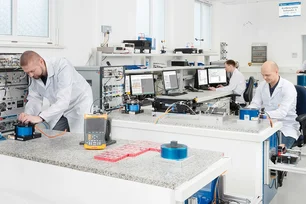
Calibration in our laboratory
To ensure reliable results, your measuring instruments, measurement chains and calibrators must be calibrated at regular intervals. You can rely on our many years of experience in our accredited laboratory.
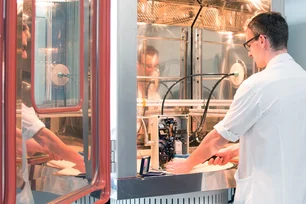
Environmental simulation
We conduct climatic and mechanical tests on sensors, measuring instruments and other electronic assemblies. This includes simultaneous functional monitoring and recording of all measured values.
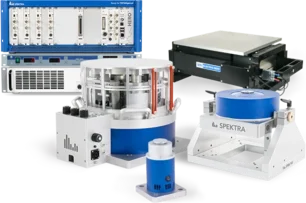
SPEKTRA technology
From cost-effective mobile systems to customized all-in-one solutions and complete laboratory equipment. Developed and manufactured in Germany, used worldwide for testing, measurement and calibration tasks.

Seminars and trainings
Expand your knowledge in a thorough and concise way to unlock your full potential. Reserve your spot now for the next user seminar — from basic to advanced training.