


Primary calibration is used for calibrations with the lowest possible measurement uncertainty. This procedure is typically used to calibrate reference standards and reference transducers. These are later used as standards for secondary calibration.
In primary calibration, the measurand is traced back to a natural constant or to other physical measurands, up to the SI base units.
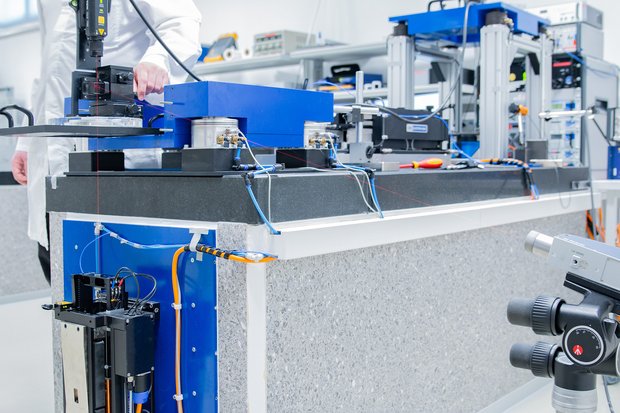
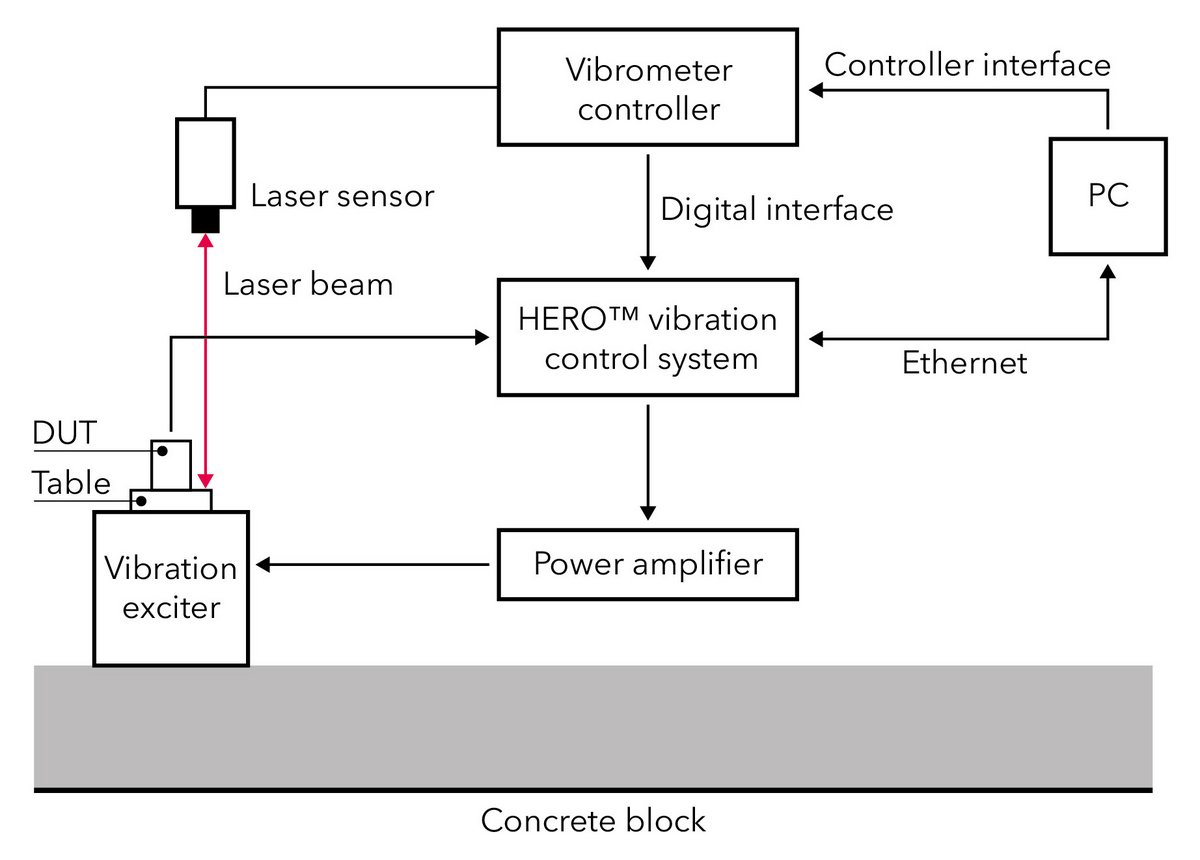
Unlike secondary calibration, in which a comparison is made with a reference standard of the same measurand, the measurand in primary calibration is traced back to another base unit. During primary calibration of accelerometers, a laser interferometer is used as a reference. The measured dynamic vibration is compared to the wavelength of the laser light used. In primary calibration, the measuring instrument thus defines an absolute measurand, without the need for prior calibration by means of other instruments.
Flexible Accreditation (in German)
When is a primary calibration required?
Primary calibration (as defined in ISO 16063-11) is the standardized method for achieving the absolute minimum measurement uncertainty. Primary calibration usually requires a laser interferometer, which provides absolute calibration by comparing the dynamic vibration with the wavelength of the laser light. This highly accurate method of vibration measurement comparison results in very low measurement uncertainty.
This high accuracy is required in national primary laboratories or wherever accelerometer transfer standards (also known as "reference standards") are produced. The low uncertainty of the reference sensor is critical for the accuracy of the comparison calibration (secondary calibration).
Primary calibration: vibration
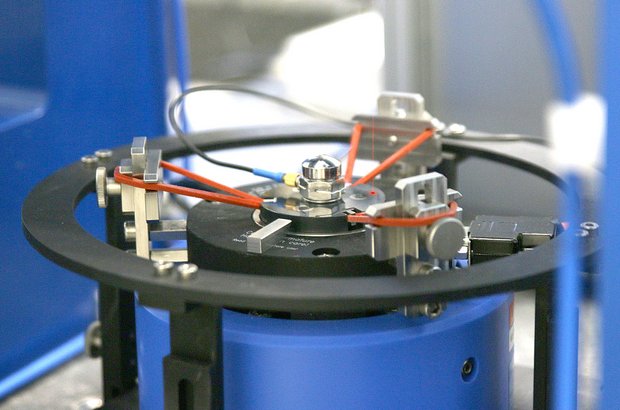
Sinusoidal primary calibration in accordance with ISO 16063 Part 11: Primary vibration calibration using a laser interferometer
- Vibration sensors
- Vibration calibrators
- Vibration measuring instruments and laser vibrometers
Vibration measuring instruments only undergo primary calibration if they measure the vibration amplitude by interferometry (laser vibrometers) or if the associated vibration sensor allows an adaptation for a primary procedure that is compliant with the calibration.

Primary calibration of acoustic measuring equipment
Primary method for pressure chamber calibration
- Laboratory standard microphones using the reciprocity method (in accordance with IEC 61094 Part 2)
Class LS2aP laboratory standard microphones (according to IEC 61094 Part 1), such as the B&K 4180 and G.R.A.S. 40AU-1, can be calibrated.